Hi everyone,
Do time constraints help you be more creative?
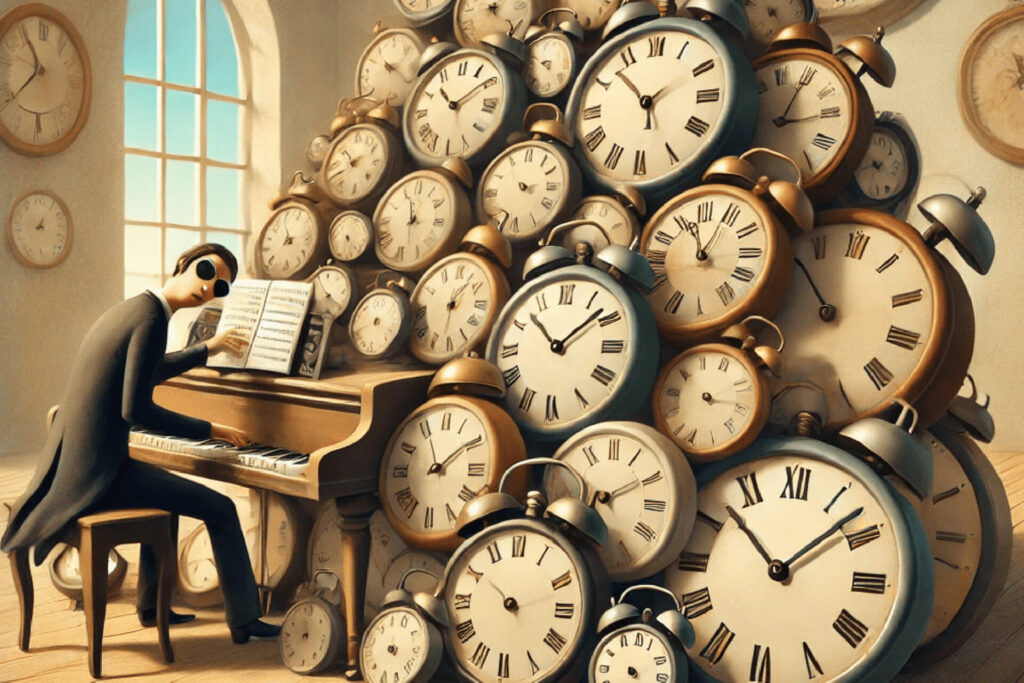
Tough question. On the one hand, if someone asks you to solve a tough riddle in 30 seconds or a bomb will explode, I’m guessing it’s going to be a little difficult to bring your most thoughtful, divergent ideas to the table. On the other hand, there are few things as demotivating as a featureless time horizon stretching out into the distance in front of you. How do you get anything done in the face of all that debilitating possibility?
Basically, some amount of time pressure is important. Without a deadline, I personally will keep tweaking the automation on a synth cutoff til my soul passes out of time and space, and my molecular makeup is re-absorbed into the cosmic soup around me, leaving only the echoes of my ghostly hands still adjusting that decaying knob.
But the fact is that time pressure can also impede your best work. “The more time pressure people feel on a given day, the less likely they will be to think creatively.” That’s the main conclusion of a study described in this Harvard Business School article. And it goes on to describe exactly how this works — the more the pressure ratchets up, the less creativity we’re able to draw on. This sort of intense deadline day pressure can even affect the days immediately afterwards. Once you’ve been locked in high-pressure, focused mode, it’s tough to shake yourself out of it.
That may be because creativity involves your mind making connections between disparate things you’ve learned, experienced, or encountered — combining, say, your interest in polyphonic Rennaissance chanting with ’80s hair metal with your interest in fixing up old Studebakers to make polyphonic distortion on old car parts. But too much pressure can crowd out your ability to make these connections. So many of us heap pressure on ourselves on a daily basis — whereas a more relaxed state of being actually allows disparate ideas to bounce around and collide in your head.
Like everything, what we really need is a balance.
I had first hand experience of this with some tight time constraints this week. I was approached by some documentary filmmakers to create a track for the end credits to a film in a style of music I don’t normally make. To add to the pressure, most of the score (as well as the temp track they used) was done by a well-known electronic artist I admire named Dan Deacon, and I only had a couple days to do it. Tough act to follow.
On the one hand, the tight timeline forced me to get my act together. It made me reflect on some of the things I’ve learned recently (including drawing on a couple lessons from Soundfly courses: creating custom virtual instruments like Ryan Lott and using high glitchy synth bass like Com Truise). It pushed me to be a little bolder than I otherwise would be and to try something new. Perhaps most importantly, I didn’t have time to be too uptight about my ideas, since I was on a deadline, which freed me from my usual perfectionism and overthinking. Big win!
At the same time, there wasn’t a ton of space for experimentation or trying something new. For the most part, I chose to rely on approaches I have used before, and tools I was familiar with. Especially toward the end, when they had a few more comments on the track but there was very little time to deal with them, it became quite difficult to deal creatively with their concerns, so I had to find compromises that were not always ideal.
Now that the track is done and accepted, I’ve been reflecting a bit on this dynamic, and come up with a few guidelines for myself to ensure the right balance between time pressure and openness going forward.
- 1) Ensure time for play at the start and in the middle of projects. This feels critical for me. If I get too deep in the zone too quickly, I will crowd out some of the looseness that I need to be original. Making sure I am scheduling time to doodle, jam, and mess around, even during a tight project, is very important.
- 2) Ensure dedicated time for collecting inputs. When you spend time learning or listening, studying how others do it, those inputs become the raw fodder to draw on in times of high pressure. It’s something many of us forget to do deliberately and in a focused way.
- 3) Keep setting deadlines. Yes, the time pressure can hold me back in some ways, but it’s also 100% necessary to keep moving forward and shipping work.
- 4) Be patient with myself if not everything I produce is always shockingly original. This one is probably a lifelong journey, but the only way to make progress is to celebrate the incremental steps it takes to get there. I know the track I submitted for the film could be better and more original — but I’m also proud that I did it anyway.
What do you think? Do you find that time pressure helps you be creative or causes you to fall into familiar patterns? I’d love to hear how you deal with it.
Yours,
Ian
This is a version of our weekly newsletter. If you want letters about the creative process in your inbox weekly, join our newsletter in the box below!