The 19th Century was an epic time — but maybe the most epic composer of all is the one who refused its call.
Welcome! This was originally published on my Substack here. It’s the first episode of a new series called How to Make Epic Music! If you enjoy it, please consider subscribing to the Substack and supporting my work. I’ve included an audio version up top with some musical cues and examples, which you can listen to in the app or download here — or feel free to just read it as usual.
Is there anything more epic than insistence?
It’s the most human of traits — that will to keep hounding away at something no matter the costs.
When I think of insistence, I imagine a young person head over heels in love, brimming with unearned confidence and willing to make a total fool of themselves to get the object of their affections. Or an ambitious person trying to move up the corporate ladder, so determined to get ahead that they’re willing to stab colleagues in the back on the way. It’s almost Shakespearean.
There are insistent voices in our heads — anxiety, anger, insecurity, guilt — all nattering away at us when we’re just trying to answer an email or make a sandwich.
And there’s the insistence of survival — the stories of people on the verge of death fighting tooth and nail to preserve their lives.
Insistence often doesn’t make sense. It can be irrational, a sort of willful blindness. There is no way to stop the insistent march of time, or the insistence of misfortune — and yet as a species, we are insistently optimistic, pushing forward all the same.
This is the first edition of How to Make Epic Music, a new series studying artists who reach the limits of what rules and common sense tell them to do, but they just say f#%& it and push on with what they’re doing anyways. You can listen to this piece as a podcast, with music, or just read on.
Today, I want to talk about insistence, and there are few pieces of music as insistent as Chopin’s Prelude Op. 28, No. 15 — commonly referred to as the “Raindrops” prelude.
I fully admit this is a strange choice, especially as a first episode in this series. The 19th Century is replete with epic music: Beethoven, Tchaikovsky, Wagner. There are massive orchestral pieces, songs with literal cannon shots in them, and operas that consume the halls of the gods in flame at the end. It was an epic time.
Instead, I chose a short piece for solo piano. Let me explain.
A distinctive character
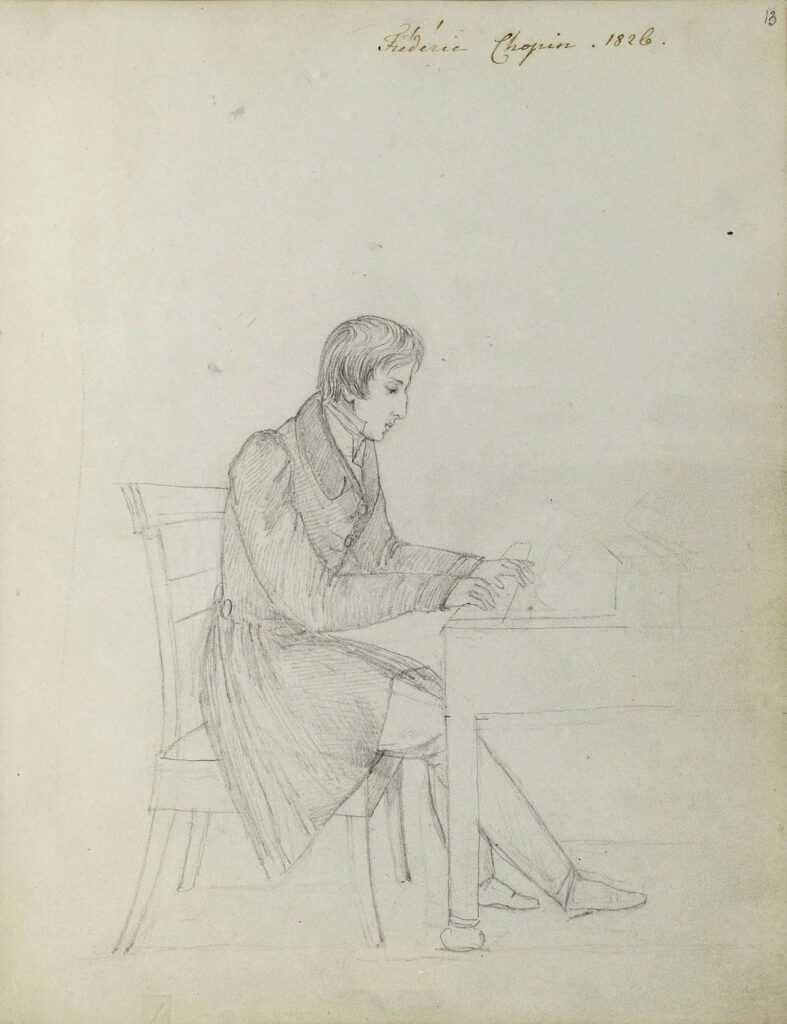
First some context. Frédéric Chopin was born in 1810 in what’s now Poland but what was then a traipsing ground for brawling emperors and Napoleonic armies. From a very young age, it was clear he was a prodigy on the piano, and despite having some important early teachers, developed a technique all his own. He wrote his first work at 7 years old and by the age of 15, he was playing for the Russian Tsar. That’s also the same year he sold his first published composition.
Nowadays, his music is part of the air we breathe, but he was incredibly distinct for his time.
Whereas his contemporaries composed largely for orchestras and chamber ensembles, he stuck almost entirely to works for solo piano, with a few early exceptions.
Whereas others composed sprawling, multi-movement concertos and operas, he wrote concise musical statements often based on unusual song forms. Études were meant to be practice exercises — but his are some of the most celebrated pieces in Western musical history. Preludes were meant to be intros to larger pieces, but he thought his were fine as is. Nocturnes were fairly unknown, mazurkas were borrowed from folk traditions, etc.
Whereas others, most notably his friend Franz Liszt, sought musical stardom on the stages of Europe, he preferred playing improvised free-flowing affairs privately for his friends. In fact, he probably only ever played something like 30 public concerts total in his whole career. I’ve checked that fact like 6 times because it seems so unbelievable to me for one of the most accomplished composers in history, especially at a time before recorded music.
In so many ways he lived in an epic time, in the shadow of the French Revolution and the Napoleonic Wars. The culture of Europe saw an evolution away from the rationality of the Enlightenment toward a fascination with emotion and the unknowable, a leaning away from the logic of the mind toward the yearnings of the soul — what we now call Romanticism.
And yet, despite all that, Chopin saw himself more as a simple craftsman than a mythic hero. He’s described as fastidious and elegant, refined, social but not given to big outward displays of emotion. His specific brand of epic can feel like one of epic constraint: How much emotion can be squeezed from a single instrument, a single note, or a single idea.
“He made a single instrument speak a language of infinity.” — George Sand
Emotional insistence
It’s this depth of emotion more than anything else that has always drawn me to his sound. Chopin was famous for playing using tempo rubato, a slowing down or speeding up of the melody for emotional effect. He’d use his left hand to keep the beat, while letting his right hand be more free-flowing and expressive.
He loved improvising, and would improvise for hours straight. Imagine sitting around with your buddies in 1830s Paris, sharing absinthe and talking revolutionary politics, when a drunk Chopin hops on the piano and starts improvising. That’s his vibe. As one of his contemporaries said:
“Chopin was a good pianist until midnight, after that his playing was sublime.”
He can be supremely lyrical, with melodies that make you want to look wistfully out a window from a train. He can be virtuosic and intense, with a barrage of voices playing a hundred miles an hour, or dark and slow, like an emo nerd feeling misunderstood. He can also be extremely textured, where the focus seems to be less on a melody than a cascade of timbre. Honestly, it’s this textural aspect of his music that makes me think he’d love modern electronic music.
And then, there are these moments of harmonic inventiveness in Chopin that sound so modern to me. Listen to the harmony in the opening of his Nocturne Op. 9 No. 1 in B♭ minor. To my untrained ear, the first few measures sound very traditionally “classical,” something that situates me in the 19th Century. But then it switches almost right away from B♭ minor to an uplifting little vamp between D♭ major and G♭ major that makes me think of, well, to be totally honest, modern musical theater.
Or listen to his Prelude Op. 28 No. 4 and Radiohead’s “Exit Music (for a Film)” back to back. Or his comfort with dissonant and unresolved chords. He’s using certain vocabularies that would not really be fully fleshed out for decades or longer.
A song written on the edge
Let’s jump ahead to the Raindrops Prelude (Op. 28 No. 15). Chopin is around 28 years old at this point. He’s living in Paris, has chronic health issues, and is making money mostly from his published music and piano lessons. He has recently taken up with an older French woman and writer named Aurore Dupin, who has two kids, a husband she’s separated but not divorced from, and police permission to dress like a man in public, which apparently was a thing back then. She’s more famous for her pen name George Sand.
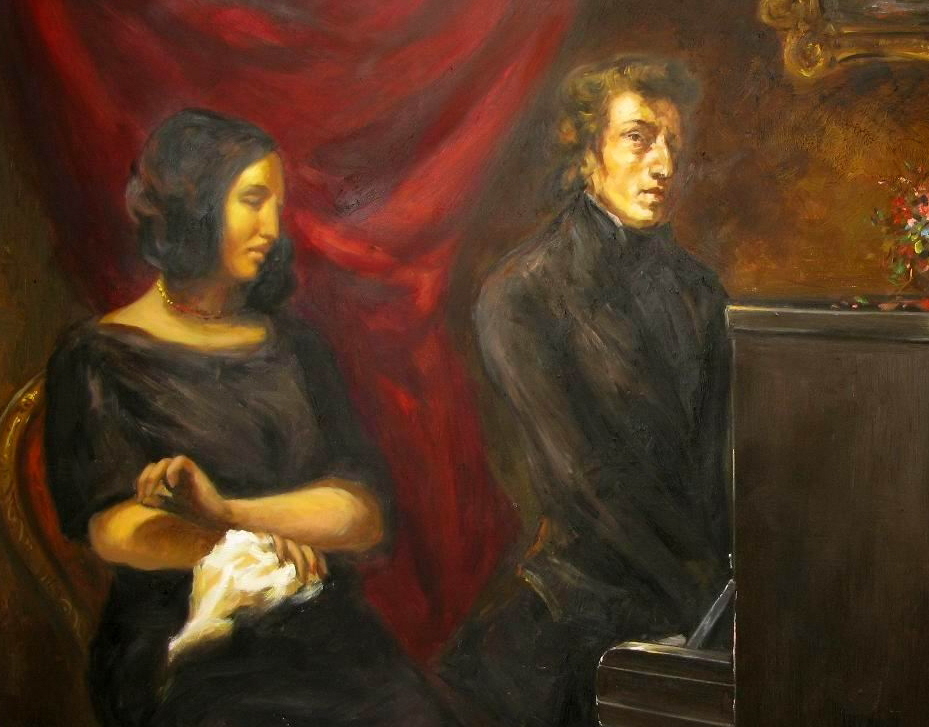
In the winter of 1838-9, the two of them ran off to the island of Majorca with Sand’s kids, partly for Chopin’s health, partly to flee fall out from Sand’s complicated past relationships. Regardless, it’s a miserable time. They rented a house but got kicked out when Chopin was diagnosed with tuberculosis, which scared the locals. They moved to a monastery in the hills, but it was cold, wet, windy, and rained incessantly. The locals hated them, and Chopin’s health worsened.
And yet, Chopin composed. He composed a lot. He completed or composed drafts for most of his 24 preludes, including No. 15. Sand writes about it all in her memoirs and her travelogue A Winter in Majorca. What she describes is a pretty dark scene:
“Death seemed to hover over our heads, waiting to seize one of us, while we alone battled to ward it off its prey. There was no human being around us who did not wish to hasten him [Chopin] to his grave and so put an end to the supposed danger of his proximity.” — George Sand in A Winter in Majorca (trans. Robert Graves), page 185
That’s the context under which the Prelude No. 15 was written.
An insistent tone
The defining feature of the tune is the pedal tone. First, the left hand, and then the right hand play a steady note throughout, an omnipresent, repetitive tone that hovers in the background, changing pitch slightly but seemingly always there. It fills every gap, ensuring there are no 8th note subdivisions free of sound until the very end of the piece. It’s just ding ding ding, relentless repetition of one or two notes the whole time.
When I was a teenager, there was this Herbie Hancock improvisation I used to listen to again and again — and try to copy on the piano. It’s from one of the live albums of dueling pianos he made with Chick Corea. Chick introduces him, and he starts playing a single, repeated note at speed, a sort of jogging in place on the keys. After a minute or so, he starts introducing different notes and chords, teasing different harmonies. Because he only has a single note, he has maximum freedom to pivot around the note harmonically. And of course, when he finally changes the note, it creates a huge surge of energy.
I took it and turned it into an improvisation game I still use a lot. Start on a single, repeated note. Settle in there for a bit, without any specific key in mind. Then, gradually start adding other notes and harmonies to build something out from that note and see where it takes you.
That’s not exactly what Chopin is doing, but there’s a similar thing happening. There’s restrained tension and harmonic freedom in the repetition of a single note that allows him to pivot around it between different chords and keys. The song starts in D♭ major with a gentle melody that evokes a certain dreaminess, a leisurely stroll down the avenue. There’s some slight syncopation, but it’s very easy-going. And because of that pedal tone, he can pivot the harmony around it, moving to an A♭ minor chord for example and it all feels very fluid.
The most epic moment
And then the B section arrives.
The B section of this song is one of my favorite moments in all music. The A♭ pedal tone becomes a G#, unknown to the listener, and the D♭ major becomes a C# minor, the parallel minor. We’re entering the darkness.
These low, muddy chords start to creep in very slowly in the bass. They’re stalking you. Each time the figure repeats, it intensifies in some way. At first, it’s an expansion of the range of the notes. Then, the right hand starts playing up an octave, tension mounting. There’s a new middle voice added to the chords. The volume and power increases steadily.
Finally, the whole thing erupts in these massive chords, and the pedal tone finally changes. It works because of the restraint that came before it.
This whole section is almost minimalist in construction, like something Philip Glass would write. The repetition against the change of tonality — it’s an embrace of tone and texture over melody and structure. It could even sound like a post-rock song, something from Explosions of the Sky. It feels like a moment out of its time.
The relentless repetition that suddenly breaks. The dynamics from super-soft to roaring loud. The creeping drama that breaks into joyful celebration. And the restraint of the whole thing. It’s subtly so epic.
Eventually, we settle back down and meander our way back to the dainty melody that started it all, leaving the storm behind us.
Insistence doesn’t have to be loud
Chopin himself didn’t put stories to his music. Every piece was named strictly with a number. But you can see why people hear the raindrop thing in this. It starts as a gentle drizzle, erupts into a storm in the middle, and comes back to a drizzle before the clouds start to part at the very end when the pedal tone finally breaks.
But rain isn’t actually this uniform. It’s not this regular.
Instead, I hear something else. I hear a steady, patient, pushing insistence, an insistence to turn over this one note like a curious child examining a rock, again and again and again. If we zoom out, it’s similar to how Chopin spent his whole life examining the emotional possibilities of a single instrument.
Insistence isn’t always loud. It can be narrow, focused, and particular. It can be going deep on a single chord, idea, instrument, or even note to discern all you can from it, to break it down again and again and again and discover what falls out. After all, splitting an atom releases a tremendous amount of energy.
But perhaps, most of all, what we have here is the insistence of a sick man, living in a turbulent time, to push through, to live his life in full despite it all, to find moments of magic in the small things he can control, and to unearth soft and transcendent beauty even in the face of stalking illness and death.
Either way, it’s pretty f$&^ing epic.
So how do you make epic music?
If we’re taking from Chopin, a few things: Don’t be afraid to go against the grain. Go epically narrow with your focus and as deep as you can on one thing to squeeze all that you can out of it, rather than spreading yourself thin. Use repetition to your advantage, building tension through insistence, and then change it at the moment of release. And of course, remember dynamics.
Bonus: It’s more epic if you battle tuberculosis while doing all this.
Epic notes…
Other insistent songs
Music for 18 Musicians by Steve Reich
Philip Glass’s Metamorphoses
“Festival” by Sigur Rós
Chopin’s Creative Process
According to George Sand, he would spontaneously come up with an idea, then spend the next two days tormenting himself to try to make it perfect before eventually coming back to the original idea and keeping it. Sand seems like a bit of an exaggerator, but that certainly resonates.
An trick for more “epicness”: Rubato
Chopin was apparently famous for not sticking very closely to timing. He had no problem slowing something down or speeding it up if it would increase the emotional power of what he was playing.
Main Sources:
- A Winter in Majorca by George Sand
- Chopin: Prince of the Romantics by Adam Zamoyski
- Lecture on YouTube: “Chopin: A Winter in Majorca” by Professor Alan Walker
- The Chopin Podcast by Ben Laude and Garrick Ohlsson
- Chopin recordings in the audio (other than the ones I played) courtesy of Creative Commons license, from https://www.classicals.de/
Special thank you to Jesse Perlstein for the thunderstorm field recordings.
Final Note:
If you enjoyed this, please subscribe and support me so I can do more of them! Next episode will be something completely different and more modern.